


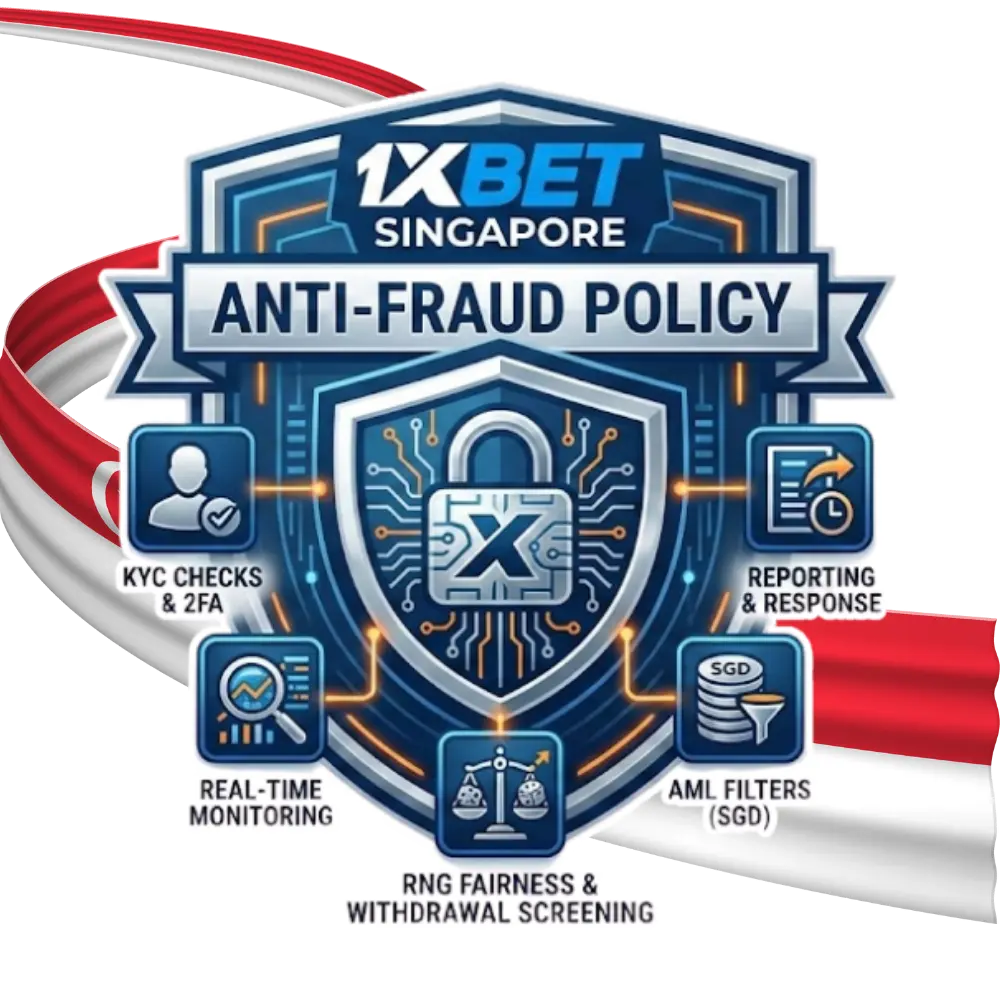
Many users search “1xbet fraud” before placing a first wager in SGD. They also ask “1xbet legal in Singapore” and “1xbet Singapore legal”. Singapore remote gambling is tightly restricted by statute. 1xBet’s Anti-Fraud Policy focuses on account integrity, payment screening, and data safety. Queries like “1xbet safe” map to these controls and user habits.
Singapore’s Gambling Control Act 2022 consolidated gambling rules and repealed older laws. The Gambling Regulatory Authority supervises gambling regulation work since 1 August 2022. Remote gambling controls include blocking, payment disruption, and ad bans. Users must assess local legality before participating. Anti-fraud controls still matter, because scams target credentials and wallets.
How 1xBet Protects Players from Fraud in Singapore
Singapore law treats remote gambling as a regulated activity, with strict enforcement tools. Users searching “is 1xbet legal in Singapore” usually want clarity before any deposit. This policy section addresses “1xbet fraud” risks through identity checks, traffic controls, and payment vetting. It also answers “1xbet safe” concerns with technical safeguards and dispute workflows.
Fraud prevention is not a legal exemption. It is a risk-control layer that reduces account takeovers, bonus manipulation, and chargeback loops. For “1xbet Singapore legal” queries, players should rely on current regulator guidance, then apply strict self-protection settings inside their account.
Advanced Encryption and Data Security Measures
Transport security commonly uses TLS 1.2+ with modern cipher suites. This encrypts login data, wallet actions, and support tickets in transit. HSTS policies reduce downgrade attacks on browsers. Certificate pinning may be used in apps to resist man-in-the-middle interception.
At-rest protection usually includes salted hashing for passwords and tokenised storage for payment identifiers. Session controls rely on short-lived tokens and device-bound refresh keys. Risk events can trigger forced logout across devices, limiting session hijack value.
Fraud-prevention toolset used in account security
- TLS encryption for session traffic
- Device fingerprinting and cookie integrity checks
- IP reputation screening and geo-velocity alerts
- Brute-force rate limits on login and reset endpoints
Account Verification and KYC Procedures
KYC targets identity theft, stolen cards, and mule accounts. Typical checks request a government ID, a selfie or liveness check, and a proof-of-address document. Name and birthdate must match the payment instrument used for SGD funding.
Two-factor authentication (2FA) hardens the account against password reuse. App-based TOTP is stronger than SMS, because SIM swaps are common. If 2FA is enabled, withdrawals and profile edits can require a second factor.
Singapore’s legal framework is strict on remote gambling access and supply. Any KYC or AML language referencing Singapore should be read as risk control, not a legal approval statement. Users should confirm what is permitted where they are located.
Real-Time Monitoring and AI-Driven Fraud Detection
Real-time monitoring looks for abnormal betting cadence and wallet behaviour. Pattern signals include repeated micro-stakes, rapid deposit-withdraw cycles, and correlated bets across linked accounts. Multi-account detection uses shared device IDs, IP clusters, and payment overlaps.
Machine-learning classifiers can score sessions for takeover likelihood. High-risk sessions may face step-up checks, like extra 2FA prompts. Suspicious withdrawals can be delayed for manual review, which lowers successful “hit-and-run” fraud.
Operational controls often tied to transaction risk
- Deposit caps and withdrawal pacing in SGD
- Velocity limits per card, e-wallet, or crypto rail
- AML screening and sanctions list checks
- Automated hold flags on chargeback-prone payment routes
Fair Play and RNG Certification
Casino fairness relies on RNG integrity and game math verification. Independent test labs commonly validate RNG output distribution and tamper resistance. Well-known labs include eCOGRA and iTech Labs; certificates, when issued, are usually linked in the game info panel.
Sportsbook fairness is different from RNG fairness. It depends on market settlement rules, odds change logs, and bet history immutability. A clear audit trail helps when users dispute voids, resettlements, or price shifts.
Partnerships with Regulatory Bodies in Singapore
Singapore’s gambling regulator is the Gambling Regulatory Authority, operating under the Gambling Control Act and related statutes. The state also applies blocking and payment disruption measures against unlawful remote gambling supply. Operators not authorised locally may still be accessed by users via offshore routes, but that does not equal local authorisation.
Anti-fraud cooperation typically includes responding to lawful requests, preserving logs, and reporting suspected laundering patterns. Users who search “1xbet legal in Singapore” should treat legality as a regulator-defined question, not a marketing claim.
Common fraud risks vs countermeasures
| Fraud risk | What it looks like | 1xBet countermeasure examples |
| Identity theft | Account opened with stolen ID | KYC document checks, selfie/liveness checks, mismatch blocks |
| Account takeover | Login from new device, sudden withdrawal attempt | 2FA, device binding, forced logout, step-up verification |
| Bonus abuse | Multiple accounts, repeated promo claims | Device/IP linkage, promo eligibility rules, automated suspension |
| Payment fraud | Stolen card deposits, chargeback attempts | 3DS where available, velocity limits, risk scoring, payout holds |
| Phishing | Fake support pages, credential harvest | Verified domains, in-app support entry points, security alerts |
Reporting Suspicious Activity and Getting Help
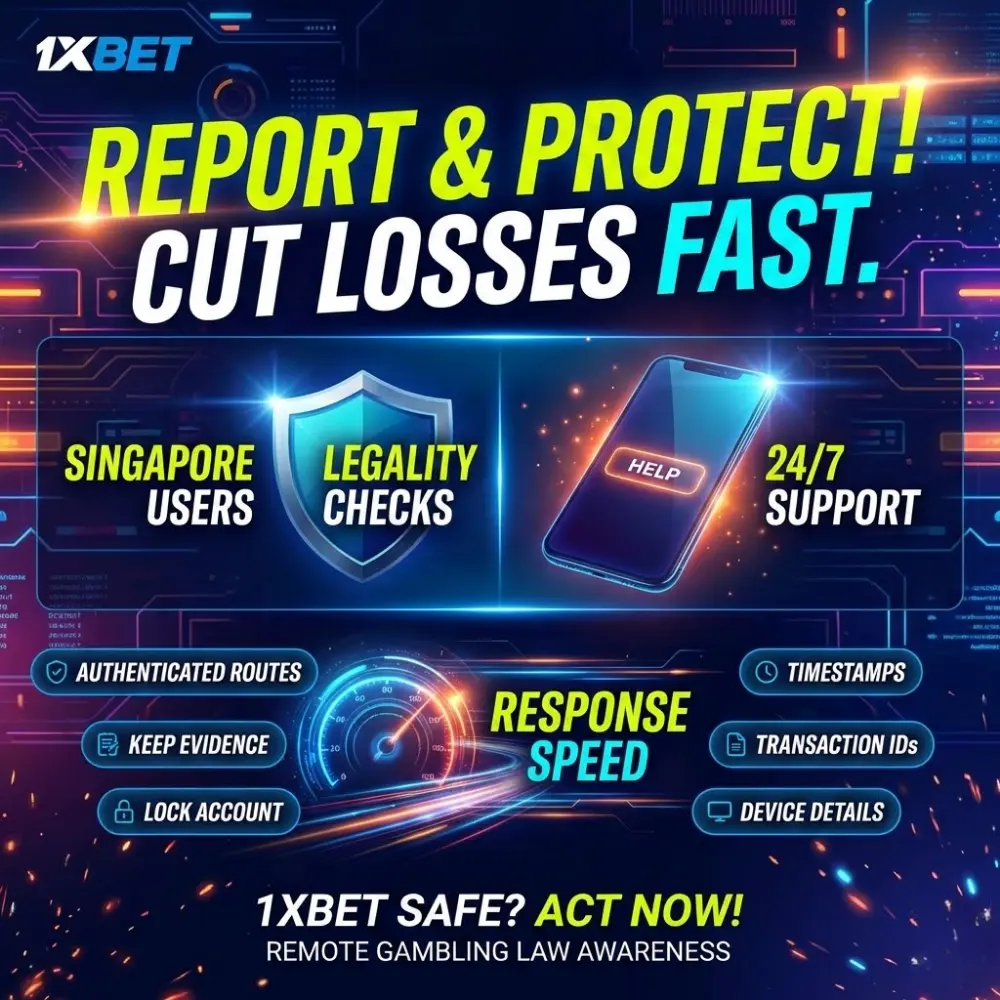
Reporting is the fastest way to cut losses from “1xbet fraud” scenarios. Singapore users also ask “1xbet legal in Singapore” and “1xbet Singapore legal” during disputes. Law in Singapore is strict on remote gambling supply and access. Reporting still protects the account, even when legality is being checked separately.
If “1xbet safe” is the search intent, the practical answer is response speed. Use authenticated support routes, keep evidence, and lock the account fast. Fraud teams prioritise cases with timestamps, transaction IDs, and device details.
Identifying Signs of Fraudulent Activity
Wallet red flags include unrecognised deposits, unexpected SGD balance changes, or withdrawal requests you did not submit. Account red flags include password reset emails you did not trigger. Message red flags include links that imitate the brand domain with extra characters.
Phishing often abuses email headers and spoofed sender names. Check full sender addresses, then avoid login via email links. Prefer direct login via the official app or typed URL, then open support from the logged-in area.
Step-by-Step Reporting Process
Use the account first, not public chat rooms. Reporting from an authenticated session reduces impersonation risk. If you suspect takeover, change password before writing the ticket.
- Log in to the 1xBet site or app.
- Enable 2FA if it is not active.
- Open Support inside the logged-in menu.
- Select Security / Fraud or an equivalent ticket category.
- Attach evidence: screenshots, transaction IDs, device list, email headers.
- Request a temporary withdrawal lock if money is at risk.
Available Support Channels and Response Times
Support access should be available 24/7 for security issues. Live chat is usually used for urgent locks. Email is better for evidence-heavy cases. A hotline, if offered for the region, is used for immediate escalation.
- 24/7 live chat inside the account area
- Email: [email protected] (use from a mailbox you control)
- Help centre ticket form in the logged-in profile
- Phone line, if shown inside the official contact page
What Happens After Reporting
First-stage handling usually sends an acknowledgement and a case number. Security staff review login history, device fingerprints, and payment logs. High-risk cases trigger payout holds and forced credential reset.
If fraud is confirmed, outcomes can include rollback of unauthorised profile edits, account recovery steps, and permanent bans for linked abuse accounts. Disputed transactions may require payment-provider coordination, especially on chargebacks.
Preventive Tips for Players
Use a unique password and a dedicated email address for gambling accounts. Turn on app-based 2FA and store backup codes offline. Never share SMS codes or email OTPs with anyone.
Keep a tight wallet posture in SGD:
- Set deposit caps and cooling-off reminders
- Avoid public Wi-Fi for deposits or withdrawals
- Review device sessions weekly and remove unknown devices
- Reject “VIP” outreach that asks for remote access tools
Response timelines by issue type
| Issue type | First response target | Typical investigation window |
| Account hack / takeover | Minutes via live chat | 24–72 hours |
| Unauthorised SGD transaction | 1–6 hours | 24–96 hours |
| Payment dispute / chargeback | 6–24 hours | 3–10 days |
| Bonus abuse accusation | 6–24 hours | 24–72 hours |
| Phishing report | 1–12 hours | 24–48 hours |
Conclusion
Singapore remote gambling is controlled by law and regulator oversight. Users searching “1xbet legal in Singapore” should verify what is permitted locally. Fraud control still matters for every user action in SGD. Encryption, 2FA, KYC checks, and behaviour monitoring reduce takeover and payment abuse. RNG testing and audit trails support fair casino outcomes and clear bet settlement records. Fast reporting through authenticated channels limits damage when “1xbet fraud” is suspected. Keep device hygiene tight, store evidence, and lock withdrawals early.