



This Privacy Policy section explains how personal data is handled on the platform. It focuses on information collected from Singapore-based users during account use. It describes what data is gathered, why it is needed, and how it is safeguarded. It also clarifies how consent works under Singapore privacy expectations.
The policy is written to support informed play and accountable processing. It covers identifiers, betting activity records, and SGD payment traces. It explains technical protections used on 1xBet online, including encrypted transport. It also outlines user rights for access, correction, and consent withdrawal.
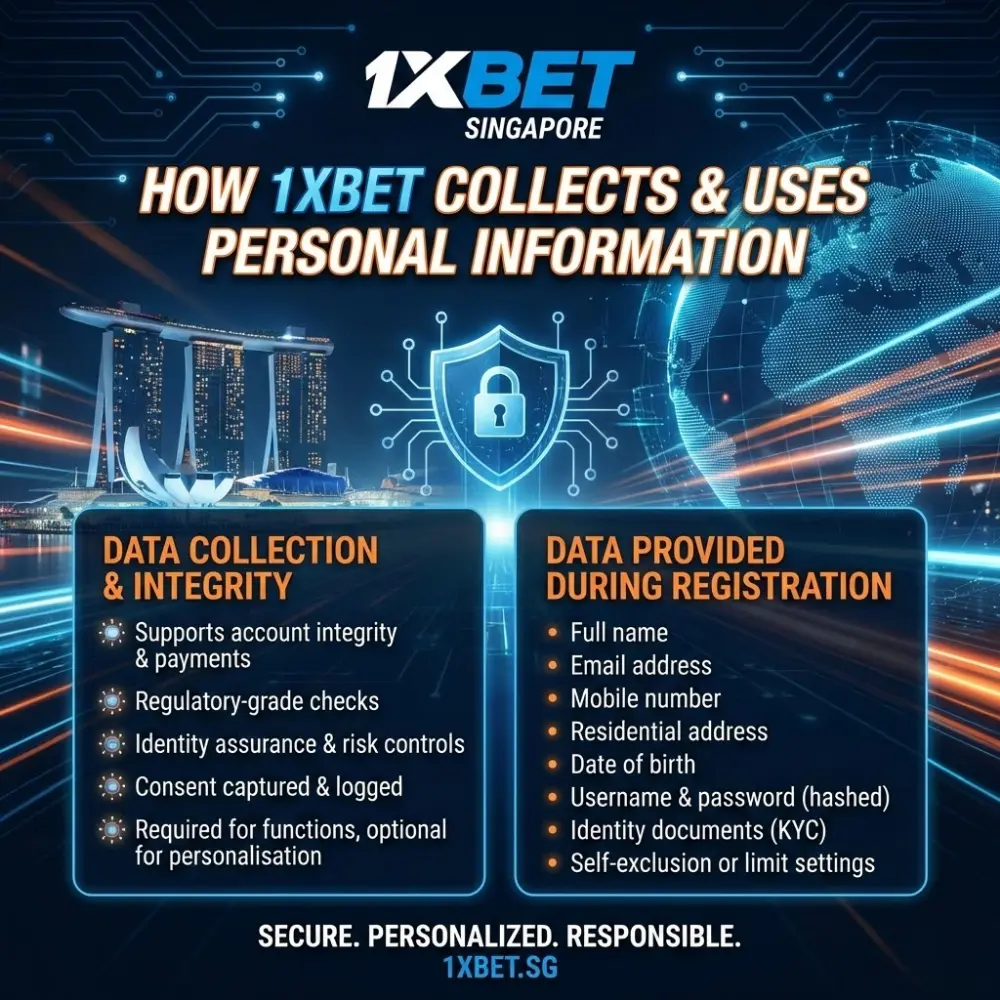
How 1xBet Collects and Uses Personal Information
Data collection supports account integrity, payment processing, and regulatory-grade checks. For 1xBet Singapore users, personal data handling in online betting is tied to identity assurance and risk controls. Consent is captured through registration flows and settings, then logged for audit. Some data is required to deliver account functions, while optional data supports personalisation.
Data you provide during registration
Collected through forms and verification steps on 1xBet online:
- Full name (as provided in the profile).
- Email address for login and notices.
- Mobile number for OTP and account recovery.
- Residential address for verification and payouts.
- Date of birth for eligibility checks.
- Username and password (password stored as a hash).
- Identity documents when required for KYC checks.
- Self-exclusion or limit settings, if selected.
Gameplay and sportsbook activity data
1xBet Singapore collects a range of data to facilitate wager settlement, mitigate disputes, and identify anomalous gameplay. This encompasses bet slips, stake amounts, odds, and settlement results, in addition to casino game sessions, round identifiers, and win/loss records. Furthermore, bonus activation events and wagering progress are monitored, along with time stamps for logins, bets, and withdrawals. Responsible gambling indicators, including limit breaches, are recorded, and interactions with customer support concerning disputes are documented to ensure transparency and facilitate resolution.
Payment and payout information (SGD)
Used to route deposits, withdrawals, and chargeback handling on 1xBet online:
- Deposit and withdrawal amounts in SGD.
- Payment method type (card, bank transfer, e-wallet).
- Tokenised payment references from processors.
- Transaction IDs, timestamps, and status codes.
- Bank or wallet destination details for withdrawals.
- Currency conversion records when applicable.
- Anti-fraud signals linked to payment attempts.
Device, app, and network identifiers
Collected via the website and 1xBet Singapore mobile use to reduce account takeovers:
| Data Type | Description |
| IP address and coarse geolocation | Inferred from IP to reduce account takeovers. |
| Browser type, OS version, and language settings | Collected to identify user environment. |
| Device model, app version, and build number | Collected for device identification and troubleshooting. |
| Device identifiers (where permitted by the OS) | Unique identifiers allowed by the operating system. |
| Session IDs, login tokens, and timeout events | Used for session management and security. |
| Crash logs and performance telemetry | Monitors app stability and performance. |
| Cookie identifiers and similar storage tags | For tracking user preferences and maintaining session states. |

How collected data is used
Account verification uses registration details to confirm identity consistency and prevent duplicate profiles. Verification can include KYC document checks and cross-field matching. When users ask, “how 1xBet uses player information in Singapore,” the practical answer is account operation plus risk containment.
Personalised promotions rely on user-chosen preferences, prior activity, and bonus eligibility rules. Promotion logic can use segmentation, frequency caps, and opt-out settings. Fraud prevention is run by the 1xBet security team through pattern detection, velocity checks, and device fingerprint signals.
Technical processing details used across 1xBet online services:
- Cookies to keep sessions active and remember settings.
- IP addresses to flag anomalous access locations.
- Encrypted transmission via HTTPS to reduce interception risk.
- Server-side logging to maintain an audit trail for disputes.
Data collection methods table
| Method | Data Type | Purpose |
| Registration form | Identity and contact fields | Create account, deliver notices, enable recovery |
| KYC upload workflow | Document images, verification status | Eligibility checks, account validation |
| Cookies / local storage | Session IDs, preferences | Keep logins stable, reduce repeated prompts |
| Sportsbook and casino logs | Bet and gameplay records | Settlement, dispute resolution, integrity monitoring |
| Payment gateway callbacks | Transaction IDs, status codes | Confirm deposits, process withdrawals in SGD |
| Support chat / email | Messages, case IDs | Solve issues, record outcomes, control abuse |
Ensuring Security and Confidentiality for Singaporean Players
Security controls are designed to reduce data exposure, account compromise, and payment abuse. 1xBet Singapore applies layered safeguards across transport, storage, and access governance. The 1xBet security team monitors login risk, payment anomalies, and suspicious automation. Controls are aimed at confidentiality in sports betting apps and web sessions.
Encryption and secure storage
Transport encryption protects data while it moves between the user device and servers. HTTPS is used to encrypt traffic, commonly backed by SSL/TLS protocols and modern cipher suites. Secure storage focuses on limiting clear-text exposure and enforcing key custody rules on 1xBet online systems.

Encryption workflow used for common account actions:
- The client starts a TLS handshake with the server.
- Certificates are validated to reduce spoofed endpoints.
- Session keys are negotiated using secure key exchange.
- Data packets are encrypted in transit under the session keys.
- Integrity checks reject tampered payloads before processing.
- Logs store only necessary fields, with masking where possible.
Storage protections typically include encrypted databases, segmented networks, and controlled key rotation. Regular internal checks and third-party audits can be used to validate configuration drift and access misuse.
Access controls and confidentiality
Access is restricted by role, with least-privilege rules and traceable audit logs. During 1xBet Singapore registration and mobile login, 2-factor authentication can be used through one-time codes. Sensitive actions can trigger step-up verification, especially for withdrawal changes.
Limited-access roles and processors may include:
- The 1xBet security team handling incident triage and risk flags.
- Compliance staff reviewing KYC status and sanctions screening.
- Customer support agents with case-based, time-limited access.
- Payment processors receiving tokenised payment references.
- KYC vendors receiving document images for verification checks.
- Infrastructure administrators working under logged privilege sessions.
Security features table
| Feature | Description | Benefit for Singaporean players |
| TLS encryption | Encrypts traffic over HTTPS | Reduces interception during SGD deposits and logins |
| Firewalls | Filters inbound and outbound traffic | Blocks common scans and brute-force attempts |
| Anomaly detection | Flags abnormal device and betting signals | Helps stop account takeovers and bonus abuse |
| 2-factor authentication | Adds OTP checks to sign-in or actions | Lowers risk of unauthorised withdrawals |
| Rate limiting | Throttles repeated requests | Reduces credential stuffing attempts |
| Audit logs | Records privileged access and changes | Supports dispute review and forensic checks |
Incident and breach response
When a suspected incident is detected, the first step is containment. Sessions can be revoked, credentials reset, and payment routes temporarily restricted. For security measures for 1xBet online in Singapore, incident handling also includes evidence capture, log preservation, and root-cause review.
Singapore’s PDPA requires a breach assessment after credible grounds exist, and notification duties can apply after assessment. Notification to the regulator must be made as soon as practicable and no later than 3 calendar days after the organisation assesses a breach as notifiable. A breach can be notifiable due to likely significant harm or significant scale, with regulations prescribing 500 affected individuals as the scale trigger.
Ongoing monitoring includes patching, rule tuning, and periodic access reviews. Controls evolve as new fraud patterns appear and as platform features change.
Conclusion
The privacy approach for 1xBet Singapore focuses on necessary data collection, controlled use, and defensive security practice. Registration details, gameplay records, device identifiers, and SGD payment traces are processed for account delivery and risk screening. HTTPS transport encryption, access restriction, and monitoring reduce exposure during betting and casino sessions. Users can request access and correction of personal data, aligning with PDPA expectations. Consent choices and opt-outs support transparent control over marketing and certain processing activities.